
Introduction
Got an app idea? Great. The very first question every startup founder asks is — how long will it take to build my mobile app?
It is a fair question. And the answer depends on what you want to build. But do not worry. This guide will walk you through everything in simple, easy language. By the end, you will know exactly how long your app will take — and what affects the timeline.
Mobile apps are everywhere in 2026. There are over 3.3 million apps on Google Play and 2.2 million on the Apple App Store. Every single one started as just an idea. The ones that succeeded were planned well and built by the right team.
Let us help you do the same.
How Long Does It Take to Build a Mobile App?
The timeline depends on how complex your app is. Here is a simple breakdown:
Simple App — 1 to 3 months This includes basic apps with 2 to 3 screens. Think of a business information app, a contact form app, or a simple booking tool.
Medium App — 3 to 6 months This includes apps with user login, a database, payment integration, and multiple features. Most startup apps fall in this range.
Complex App — 6 to 12 months or more This includes full marketplaces, social platforms, multi-vendor systems, or apps with AI and advanced features.
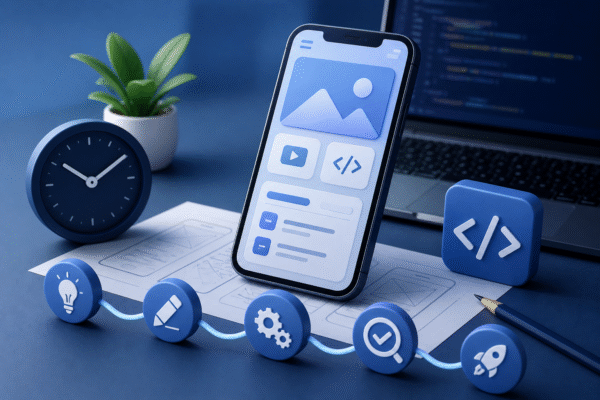
The 7 Stages of Building a Mobile App
Building a mobile app is not just about writing code. There are 7 important stages. Each one takes time. Skipping any stage is the number one reason projects fail or go over budget.
Stage 1 — Requirement Gathering
This is the starting point. The development team sits with you to understand your goals, your users, and the features you need. The clearer you are at this stage, the faster the rest of the project goes.
Stage 2 — UI/UX Design
Designers create the look and feel of your app. This includes all screens, buttons, fonts, and colours. Good design keeps users coming back. Poor design makes users delete your app after one use.
Stage 3 — Prototype
A prototype is a clickable demo of your app. It is not the real product. But it lets you test the idea and catch problems before any coding starts. This step saves both time and money.
Stage 4 — Development
This is the longest and most important stage. Developers build the frontend, which is what users see, and the backend, which is the engine that makes everything work behind the scenes.
Stage 5 — Quality Assurance and Testing
Every feature, button, and screen gets tested on multiple phones and operating systems. The goal is to find and fix all bugs before your real users find them. Never skip this stage.
Stage 6 — Deployment and Launch
Your app gets submitted to the App Store or Google Play for review. Apple takes 1 to 3 days. Google Play takes a few hours to 7 days. Once approved, your app is live.
Stage 7 — Support and Maintenance
After launch, your app needs regular updates and bug fixes. New features get added based on user feedback. A good development company will stay with you even after the app goes live.
What Makes Apps Take Longer Than Expected?
This is where most blogs fall short. They give you a timeline but never tell you why projects get delayed. Here are the most common reasons:
Unclear requirements If you keep changing what you want mid-project, the team has to redo work. This can add weeks. Always finalise your feature list before development begins.
Too many features in version one This is the most common mistake startups make. You have 30 great ideas and you want all of them in the first version. Do not do this. Start with only the most important features. This is called an MVP or Minimum Viable Product. Launch it first, get real feedback, then add more.
Wrong platform strategy Building separate apps for iOS and Android takes longer and costs more. Cross-platform development using Flutter or React Native allows you to build one app that works on both. This can save 30 to 40 percent of your development time.
Too many third-party integrations Adding payment gateways, GPS maps, social logins, or SMS verification all take extra time. Plan these in advance so they do not slow you down mid-project.
Slow communication If your team asks a question and you take a week to reply, that is a week of lost time. Stay involved in the project. Give quick feedback. This is one of the easiest ways to keep your project on track.
iOS vs Android — Where Should You Launch First?
This is a question most founders struggle with. Here is a clear and simple answer.
If your target users are in India or Southeast Asia, launch on Android first. Android has the largest market share in these regions.
If your target users are in the US, UK, or Australia, start with iOS. Users in these markets tend to spend more on apps.
If you want to reach both audiences at the same time and your budget is limited, go cross-platform. One codebase, two platforms, less time, less cost.
How Much Does a Mobile App Cost in India?
Cost and timeline are closely connected. Here is a rough estimate:
- Simple App — ₹2 to ₹5 lakhs
- Medium App — ₹5 to ₹15 lakhs
- Complex App — ₹15 lakhs and above
These are estimates. The final cost depends on features, team size, technology used, and the timeline agreed. Always ask for a detailed project breakdown before you sign anything.
Tips to Speed Up Your App Development
Here are simple things you can do right now to keep your project moving fast:
- Start with an MVP and launch with core features only
- Write a clear brief before approaching any development company
- Give quick feedback during every design and development round
- Choose cross-platform development if time and budget are tight
- Pick a team that does testing while building, not only at the end
- Never add new features in the middle of development — save them for version two
These small steps can save weeks of time and thousands of rupees.
Top Mobile App Development Companies to Consider
Finding the right development partner is just as important as having a great idea. Here are five trusted companies that can help you build your mobile app:
1. Talentrise Technokrate Pvt Ltd A well-established IT company with over 10 years of experience in mobile app development, web development, blockchain, and cloud solutions. Known for quality delivery, transparent communication, and full support from idea to launch and beyond.
2. Daksh Vikash Pvt Ltd A reliable software and app development company that works with startups and growing businesses. They are known for their client-first approach and delivering clean, scalable solutions on time.
3. Avestan Technologies LLC A technology company focused on building scalable digital products and modern mobile applications for businesses across different industries.
4. Softwave Technify Specialises in cross-platform mobile app development with a strong focus on UI/UX design and clean code. Known for delivering projects on time and within budget.
5. Ryne Infotech An end-to-end mobile app and web development company serving startups and enterprises across India. Known for professional delivery and strong client relationships.
Conclusion
Building a mobile app is one of the best investments a startup can make in 2026. But it only works when it is done right. Rushing the process or skipping stages will always cost you more in the long run.
The smartest approach is simple. Start lean. Plan well. Pick the right team. Launch fast. Listen to your users. Keep improving.