Introduction
What is ERP software and does your business actually need it? These are two of the most common questions business owners ask when they start hearing about ERP systems. However, most explanations are full of technical terms that make the concept harder to understand than it needs to be.
Therefore, this guide will explain ERP software in the simplest way possible. Furthermore, by the end of this blog, you will know exactly what ERP software is, how it works, and whether your business is ready for it in 2026. In addition, we will look at real examples so you can see how ERP is being used by businesses just like yours.
So let us start from the very beginning.
What is ERP Software?
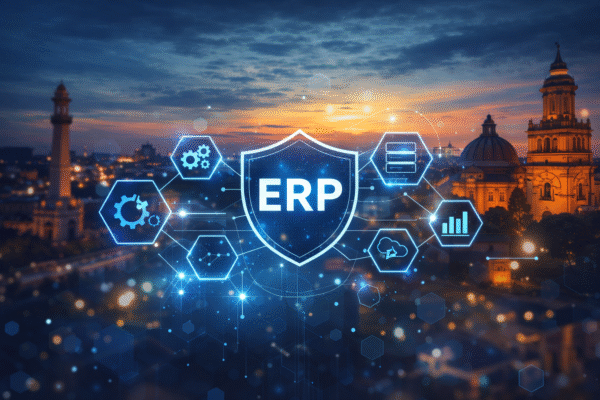
ERP stands for Enterprise Resource Planning. However, do not let the name confuse you. In simple words, ERP software is a system that connects all the different parts of your business into one single platform.
For example, think about how many different tools your business uses every day. You might have one system for accounting, another for inventory, another for sales, and yet another for human resources. Furthermore, each of these systems works separately, which means your team has to manually transfer data between them. As a result, errors happen, time is wasted, and important information gets lost.
ERP software solves all of this by bringing everything together in one place. Therefore, your accounts, inventory, sales, HR, purchasing, and customer data are all connected and visible on one single dashboard. In addition, when one department updates something, every other department sees the change instantly.
How Does ERP Software Work?
ERP software works by creating one central database that all departments in your business share. Furthermore, every time someone enters data into the system — whether it is a new sale, a purchase order, or a payroll entry — that data is instantly updated across the entire system.
Here is a simple example to understand it better.
Imagine a customer places an order on your website. Without ERP, your sales team records the order, then manually informs the warehouse, who then manually informs accounts to raise an invoice. As a result, the process is slow, error-prone, and depends on people remembering to pass information along.
However, with ERP software, placing the order automatically updates the inventory, triggers the warehouse to prepare the shipment, and generates the invoice in accounts — all at the same time. Therefore, the entire process happens faster, more accurately, and with far less manual effort.
What are the Main Features of ERP Software?
ERP software covers many areas of your business. Furthermore, most modern ERP systems include the following key modules.
Accounting and Finance ERP software manages all your financial transactions including invoices, payments, expenses, and financial reports. As a result, you always have a clear and accurate picture of your business finances in real time.
Inventory Management ERP tracks your stock levels automatically. Therefore, you always know exactly how much inventory you have, what needs to be reordered, and where your products are at any given time.
Sales and CRM ERP software manages your entire sales pipeline from leads to closed deals. Furthermore, it stores all customer information in one place so your sales team always has the context they need to close deals faster.
Human Resources ERP handles employee records, attendance, payroll, and performance tracking. As a result, your HR team spends less time on paperwork and more time on people.
Purchasing and Procurement ERP manages your supplier relationships, purchase orders, and procurement processes. Therefore, your team can place orders, track deliveries, and manage supplier payments all in one system.
Reporting and Analytics ERP generates detailed reports on every part of your business. Furthermore, these reports help business owners make smarter decisions based on real data rather than guesswork.
What is ERP Software Used For in Real Businesses?
ERP software is used across many industries in 2026. Here are some simple real-world examples to help you understand how it works in practice.
Manufacturing A manufacturing company uses ERP to manage raw material inventory, production schedules, quality control, and finished goods delivery. As a result, production runs smoothly and waste is reduced significantly.
Retail A retail business uses ERP to track stock across multiple stores, manage supplier orders, process sales, and handle customer returns. Furthermore, the system automatically reorders popular products before they run out of stock.
Healthcare A hospital uses ERP to manage patient records, staff schedules, billing, and medical supplies. As a result, doctors and nurses spend more time with patients and less time on administration.
E-Commerce An online store uses ERP to sync orders from multiple sales channels, manage warehouse operations, process payments, and handle customer service. Therefore, the entire order fulfilment process becomes automated and error-free.
Construction A construction company uses ERP to manage project budgets, contractor payments, material procurement, and project timelines. Furthermore, managers can track the progress of multiple projects simultaneously from one dashboard.
Cloud ERP vs On-Premise ERP
In 2026, businesses have two main options when it comes to ERP software — cloud-based ERP and on-premise ERP. However, most small and medium businesses are choosing cloud ERP for several important reasons.
Cloud ERP Cloud ERP is hosted on the internet and accessed through a browser or app. Furthermore, you do not need to buy any expensive hardware or servers. As a result, the setup cost is much lower and you can start using it within days. In addition, cloud ERP is updated automatically by the provider so you always have the latest features without doing anything yourself.
On-Premise ERP On-premise ERP is installed on your own servers inside your office. However, this requires a significant upfront investment in hardware and IT infrastructure. Furthermore, your team is responsible for maintaining, updating, and securing the system. As a result, on-premise ERP is generally more suitable for very large enterprises with dedicated IT teams.
Therefore, for most small and medium businesses in India, cloud ERP is the smarter and more practical choice in 2026.
Does Your Business Need ERP Software?
This is the most important question. However, the answer depends on the size and complexity of your business. Here are some clear signs that your business is ready for ERP software.
You are managing everything on spreadsheets If your team is using multiple Excel spreadsheets to manage inventory, sales, and accounts, you are already experiencing the limitations of manual systems. Therefore, ERP is the natural next step.
Your departments are not communicating well If your sales team does not know what is in stock, or your accounts team does not know what orders have been placed, that is a clear sign your systems are not connected. Furthermore, ERP solves this problem completely.
You are making decisions without real data If you find yourself guessing about your business performance rather than looking at accurate reports, ERP gives you the real-time data you need to make confident decisions.
You are growing fast As your business grows, manual systems become impossible to manage. Therefore, ERP gives you the foundation to scale your operations without losing control or quality.
You are losing customers due to errors If wrong orders, late deliveries, or billing mistakes are affecting your customer satisfaction, ERP helps eliminate these errors by automating and connecting your processes.
Trusted Companies That Can Help You Implement ERP Software
If you are ready to explore ERP software for your business, here are five trusted technology companies that can guide you through the process.
1. Talentrise Technokrate Pvt Ltd Over 10 years of experience in custom software development including ERP solutions for businesses across India. They help companies choose, customise, and implement the right ERP system for their specific needs.
2. Daksh Vikash Pvt Ltd A reliable technology partner for startups and growing businesses. They offer custom software and ERP solutions tailored to specific business processes and industry requirements.
3. Avestan Technologies LLC Specialises in scalable enterprise software solutions including ERP implementation and digital transformation for businesses of all sizes.
4. Softwave Technify Known for building modern digital products and business software solutions. They help businesses implement ERP systems that are easy to use and simple to manage.
5. Ryne Infotech End-to-end software development and ERP implementation services for startups and enterprises. Known for professional delivery and strong post-implementation support.
Conclusion
ERP software is one of the most powerful tools a growing business can invest in. However, it is only worth implementing when your business is ready for it and when it is set up correctly by the right team.
In summary — ERP software connects all parts of your business into one single system, eliminates manual errors, saves time, and gives you real-time data to make better decisions. Furthermore, with cloud ERP now available at affordable prices, even small businesses in India can access enterprise-level tools in 2026.