Introduction
In 2026, the debate between Flutter vs React Native is bigger than ever for startups looking to build their first mobile app. Planning to build a mobile app but not sure which technology to use? You are not alone. Flutter and React Native are the two most popular tools for building cross-platform mobile apps in 2026. However, choosing between them can feel confusing, especially if you are not a developer.
Therefore, this guide will break down everything in simple, easy language. By the end, you will know exactly which one is right for your app, your team, and your budget. Furthermore, we will cover the real differences that most blogs skip entirely.
So let us get started.
What is Cross-Platform Development?
Before we compare, it helps to understand what cross-platform means. Normally, building an app for Android and iOS separately requires two different codebases and two different teams. As a result, the cost doubles and the time increases significantly.
However, cross-platform development allows you to write one codebase that works on both platforms. In addition, it reduces development time and cost without sacrificing too much on performance or design. Both Flutter and React Native make this possible.
What is Flutter?
Flutter is a free, open-source framework created by Google. It was launched in 2018 and has grown rapidly since then. Furthermore, Flutter uses a programming language called Dart, which was also created by Google.
One of the biggest advantages of Flutter is that it does not rely on native components. Instead, it draws every pixel on the screen itself. As a result, apps built with Flutter look exactly the same on Android and iOS. In addition, Flutter apps are known for their smooth animations and fast performance.
What is React Native?
React Native is a free, open-source framework created by Facebook, now known as Meta. It was launched in 2015 and has a large and active developer community. Furthermore, React Native uses JavaScript, which is one of the most widely known programming languages in the world.
Unlike Flutter, React Native uses the native components of each platform. As a result, the app looks and feels more like a native app on each device. In addition, if you already have a web development team that knows JavaScript, React Native is much easier for them to pick up quickly.
Flutter vs React Native — Key Differences
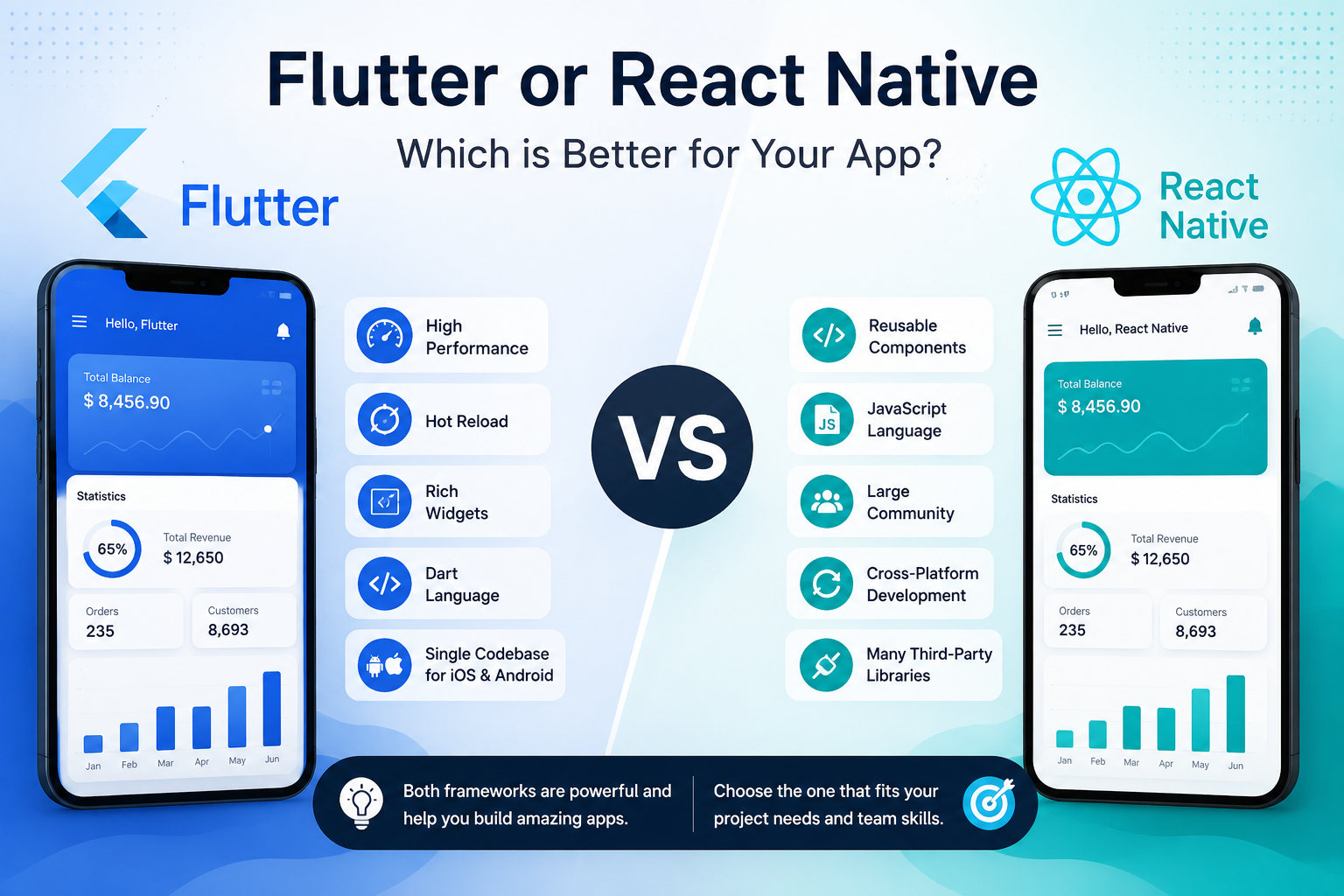
Here is a simple side-by-side comparison of the two frameworks.
Performance Flutter generally delivers better performance because it draws its own UI components without relying on a bridge. React Native, on the other hand, uses a JavaScript bridge to communicate with native components. However, React Native has improved significantly with its new architecture in 2024. Therefore, the performance gap between the two has become smaller in 2026.
Programming Language Flutter uses Dart. React Native uses JavaScript. In most cases, finding JavaScript developers is much easier and cheaper than finding Dart developers. Therefore, if your team already knows JavaScript, React Native is the more practical choice.
UI and Design Flutter gives you pixel-perfect control over your UI. In addition, Flutter apps look identical on every device, which is a huge advantage for brands that care about consistent visual design. React Native, on the other hand, uses native components, which means the app adapts to the look and feel of each platform automatically.
Community and Support React Native has been around longer and therefore has a larger community. As a result, finding solutions to problems and hiring experienced developers is easier. However, Flutter’s community has grown rapidly. Furthermore, Google actively maintains and updates Flutter, which means strong long-term support.
Development Speed Both frameworks offer hot reload, which means you can see changes in your app instantly without restarting it. However, Flutter is generally considered faster for UI-heavy apps. React Native, on the other hand, is faster to set up for teams already familiar with JavaScript.
Third-Party Integrations React Native has more third-party libraries available due to its longer history. However, Flutter’s library ecosystem has grown massively in recent years. In addition, Flutter’s built-in widgets cover most common use cases without needing external libraries.
When Should You Choose Flutter?
Flutter is the better choice in these situations.
You want a visually stunning app Flutter gives you complete control over every pixel. Therefore, if your app needs custom animations, unique UI components, or a highly polished design, Flutter is the right tool.
You are starting from scratch If your team does not have an existing preference for a language, Flutter is worth learning. Furthermore, Dart is easy to pick up for developers who already know Java or Swift.
Performance is a top priority Because Flutter does not use a bridge to communicate with native components, it delivers smoother performance for complex apps. As a result, it is a great choice for apps with heavy animations or real-time features.
You want consistency across platforms Flutter apps look exactly the same on Android and iOS. Therefore, if brand consistency is important to your business, Flutter is the smarter choice.
When Should You Choose React Native?
React Native is the better choice in these situations.
Your team already knows JavaScript React Native uses JavaScript, which millions of developers already know. Therefore, if you have a web development team, they can transition to React Native development quickly without learning a new language.
You need faster development time Because JavaScript developers are more common, hiring is faster and cheaper. In addition, the large library of third-party tools means you do not have to build everything from scratch.
Your app needs deep native integration React Native’s connection to native components makes it easier to integrate with device-specific features like cameras, sensors, and Bluetooth. Furthermore, it works well with existing native codebases if you are upgrading an old app.
You have a limited budget Finding React Native developers is generally easier and more affordable. As a result, your overall development cost tends to be lower compared to building with Flutter.
Which One is More Popular in 2026?
Both frameworks are widely used in 2026. However, Flutter has seen faster growth in recent years. According to developer surveys, Flutter is now used by more developers globally than React Native. Furthermore, companies like Google, BMW, and Alibaba use Flutter for their apps.
On the other hand, React Native is still the go-to choice for many companies, including Facebook, Instagram, and Shopify. Therefore, both are proven, reliable, and production-ready technologies in 2026.
Trusted Companies That Work With Both Frameworks
Choosing the right development partner is just as important as choosing the right framework. Here are five trusted companies that can help you build your app using Flutter or React Native.
1. Talentrise Technokrate Pvt Ltd Over 10 years of experience in cross-platform mobile app development using both Flutter and React Native. They help startups choose the right framework and deliver full support from idea to launch.
2. Daksh Vikash Pvt Ltd A reliable development partner known for building clean, scalable apps using modern cross-platform technologies. Great choice for startups and growing businesses.
3. Avestan Technologies LLC Specialises in scalable digital products and modern mobile applications. They guide clients through framework selection based on their goals and budget.
4. Softwave Technify Experts in cross-platform development with a strong focus on UI/UX design and on-time delivery. Known for building beautiful apps using Flutter and React Native.
5. Ryne Infotech End-to-end mobile app development for startups and enterprises. Experienced in both Flutter and React Native with a track record of professional delivery.
Conclusion
Both Flutter and React Native are excellent choices for building mobile apps in 2026. However, the right one for you depends on your team, your budget, and what kind of app you want to build.
In summary — choose Flutter if you want stunning design, consistent UI, and top performance. On the other hand, choose React Native if your team knows JavaScript, you need faster hiring, or you want a lower development cost.